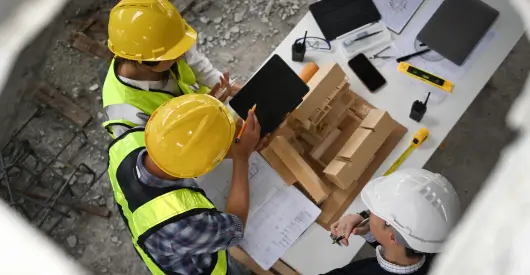
In construction, it’s common for projects to face delays when teams are not in sync. When your field and office teams don’t communicate well, the results are costly.
Industry reports show that poor data and miscommunication can lead to major rework, which eats up a large part of a project’s budget.
This messy process of endless emails and lost papers creates problems between general contractors, subs, and owners, often causing disagreements that can lower a project’s profit.
Luckily, today’s construction management software is designed to solve these issues. It creates a single, connected system, which provides a clear path away from the chaos.
The best part of modern construction management software is that it puts all project information in one place. You can think of it as one online hub for the whole project.
Here, the owner, general contractor, and every subcontractor see the exact same plans and updates.
This is a big change from the old way, where teams kept important files in different emails, spreadsheets, and folders.
When information is everywhere, people often work from outdated plans, which leads to mistakes. A central system stops this confusion.
With good construction document management, your team works from the same script. This helps everyone trust each other more and keeps the project on time.
You can also read: Construction Project Management: Manual Workflow vs. SuperConstruct.
When everyone works from the same playbook, technology makes sure that playbook is always updated.
With software on a phone or tablet, field teams can share daily logs, photos, and RFIs instantly from the job site.
Because of this instant information, project managers in the office know what’s going on without waiting.
This helps them see how the job is going, spot problems early, and decide what to do more quickly. This connection is key to teamwork.
In fact, studies show that collaborative project models, which use technology to connect teams, can be finished much faster than older methods.
Moreover, seeing things in real-time helps teams solve problems before they turn into big delays.
This real-time speed also helps with slow paperwork. The manual process for construction pay apps and approvals often causes the most problems.
Emailing forms like the G702 and G703 by hand wastes hours of a team’s day. This extra work leads to late payments and can hurt the relationship between teams.
Construction workflow automation software makes a huge difference here.
Instead of typing things by hand, the system creates correct AIA invoicing forms for you. It checks the project’s Schedule of Values to create a correct invoice.
The software then sends these documents to the right people for approval. Your team can add digital signatures in just a few minutes, instead of waiting for days.
Automating lien waiver management lets your team focus on building, not paperwork, and makes sure everyone gets paid faster.
You can also read: 3 Reasons General Contractors Can’t Ignore Electronic Payments Anymore.
Finally, good teamwork needs great organization. A single project creates thousands of documents, from plans to change orders. Without one system, teams often lose these important files.
In fact, a major industry problem is that a lot of project data is lost or hard to find by the time a job is done.
Effective construction document management software solves this.
It gives you a secure, digital place to keep all of your project’s documents. This means no more digging through emails for an RFI or wondering if you have the latest plans.
Moreover, the software stores everything in one place and makes it easy to access anytime. This simplifies project audits and makes the final digital construction closeout process much smoother.
You can also read: 4 Reasons General Contractors Are Winning with Construction Tech.
In modern construction, technology is no longer an option; it is needed for success. The right software helps fix the biggest issues that slow down projects.
It gets everyone on the same page, uses real-time data, simplifies payments, and keeps documents organized.
But to truly fix the problem, you need one platform that handles both project work and difficult construction payments.
This is why we built SuperConstruct!
It is one platform made to solve these exact problems. SuperConstruct streamlines pay applications and also provides one central location for your daily logs and RFIs.
Moreover, it creates a smooth communication channel for everyone involved.
This gets rid of the guesswork from doing things by hand. It puts your project collaboration on autopilot, so everyone is connected and moving forward together.
Ready to transform your project collaboration and boost productivity with construction management software? Learn more about how SuperConstruct can streamline your next project.
Want to see the real numbers? Try our free Cost-Benefit Calculator to see how much time and money you can save by automating your pay application process!
You should start by finding the biggest issue in how your team communicates. For many contractors, this is the slow and frustrating process of managing construction pay apps and lien waivers. A tool that solves this specific problem will deliver value right away and show your team the benefits of technology.
That can be a concern, but today’s software is designed to be easy to use. Look for cloud construction software you can use on any device, phone, tablet, or desktop. Platforms with simple layouts and good customer support make the change much smoother for your office and field teams.
Better collaboration directly boosts your bottom line. When teams communicate well, there is less rework, which saves money on labor and materials. Automated payment workflows help you pay faster and lead to fewer disagreements. Finishing projects on time and on budget increases profit on your current job and builds your reputation for future work.
Automating construction payments helps contractors and developers improve cash flow, reduce delays, increase accuracy, and streamline project operations.
If you’re a project owner in 2026, you already know that the “old way” of building, marked by fragmented spreadsheets, frantic phone calls, and the
In the high-stakes world of construction, time isn’t just money; it’s reputation, liquidity, and the difference between a thriving firm and a struggling one. Yet,
In the world of construction, “surprises” are rarely a good thing. Whether it’s a sudden $50,000 change order or a three-week delay because a subcontractor