


What Is Construction Management? A Practical Guide
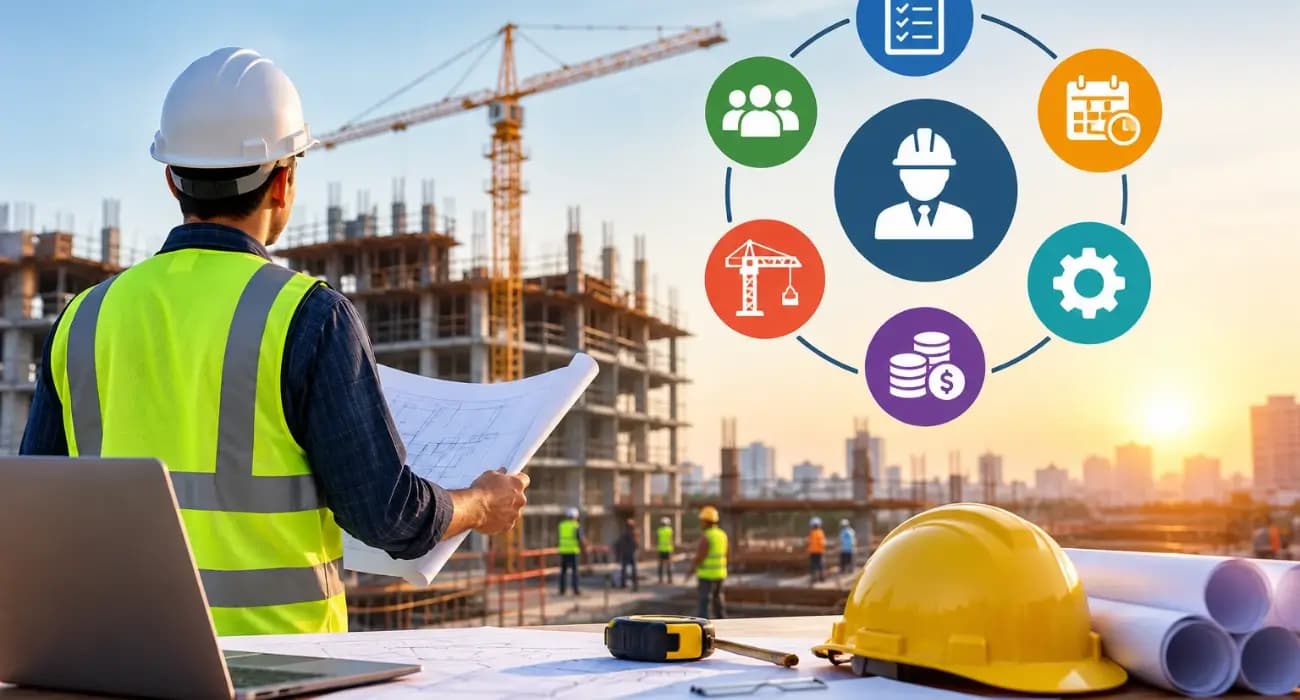
A finished building looks simple from the street. Behind it are thousands of decisions.
Which trade goes first? Whether the steel arrives before the crane leaves. Who pays for the extra footing nobody saw on the drawings? Whether this month's pay app matches what was actually built.
Someone has to keep all of that moving in the same direction. That job is construction management.
When it's done poorly, the results are expensive. McKinsey found that large projects typically take 20% longer than scheduled and run up to 80% over budget. (Those figures cover large capital projects, but the same problems show up on smaller jobs.)
This guide explains what construction management is, what construction managers actually do, how projects move through each phase, and how construction project management software supports the work.
What Is Construction Management?
Construction management is the planning, coordination, and control of a construction project from the first idea to the final handover.
The goal is simple to state and hard to achieve: deliver the project on time, on budget, safely, and to the agreed quality.
The term is used in two ways.
- First, it describes a discipline. Anyone who manages scope, schedule, cost, quality, safety, and communication on a project is doing construction management, whether their title is project manager, superintendent, or owner's rep.
- Second, it describes a delivery method. In "construction management at-risk," a construction manager joins during design, then guarantees a maximum price and manages the build. In "agency" construction management, the CM advises the owner but does not hold the trade contracts.
Most of this article focuses on the first meaning: the day-to-day work of running a project.
Construction Management vs. Construction Project Management
The two terms overlap so much that most people use them interchangeably.
If there is a difference, it's scope.
Construction project management usually refers to managing one project: its schedule, budget, team, and paperwork.
Also, construction management can cover the bigger picture, such as how a firm delivers projects, manages risk across its portfolio, and works with owners during design.
In practice, both come down to the same core functions, covered below.
You can also read: What Is Construction Management Software and How Does It Work?
What Does Construction Management Do?
1. Plans the Project Before Work Starts
Preconstruction is where most of a project's success is decided.
Construction managers review drawings, build estimates, plan the sequence of work, identify risks, and help the owner make design decisions that balance cost and quality.
2. Builds and Manages the Schedule
A construction schedule shows what happens, in what order, and how long each phase should take.
Managing it means tracking actual progress against the plan and adjusting quickly when weather, materials, or labor cause delays.
Good schedules also account for dependencies. Drywall can't start until rough-in inspections pass, and a two-day slip on one trade can push back every trade behind it. Spotting those ripple effects early is a big part of the job.
You can also read: Tracking Projects With Schedules of Values (SOV) Software
3. Controls Costs
Construction managers set the budget, track committed and actual costs, and watch for overruns.
On most commercial jobs, this starts with a schedule of values, which breaks the contract into line items used for billing and cost tracking.
You can also read: 10 Leading Construction Expense Management Software
4. Manages Contracts and Change Orders
Every project runs on contracts: between the owner and the GC, and between the GC and each sub. When scope changes, construction managers price the change, get it approved, and update the contracts.
Poor documentation here is a major source of conflict.
In the 2025 Arcadis disputes report, errors and omissions in contract documents were the leading cause of construction disputes in North America.
You can also read: 6 Change Order Challenges & How SuperConstruct Helps in Managing Them
5. Oversees Quality
Quality control means making sure the work matches the plans and specifications. That includes submittal reviews, inspections, and punch lists before handover.
Catching a quality problem during the work is far cheaper than tearing it out later, which is why inspections are scheduled throughout the project, not just at the end.
6. Keeps the Site Safe
Safety is one of the most serious parts of the job. The Bureau of Labor Statistics recorded 1,034 construction worker deaths in 2024, roughly one in five U.S. workplace fatalities.
Construction managers enforce safety plans, run training, and make sure hazards are addressed before someone gets hurt.
You can also read: Construction Management Software for Project Managers: A Practical Guide
7. Keeps Everyone Informed
Owners, architects, engineers, subs, suppliers, inspectors, and lenders all need different information at different times.
Construction managers handle RFIs, meetings, daily logs, and reports so decisions get made quickly and on the record.
When this breaks down, rework follows.
PlanGrid and FMI found that poor project data and miscommunication were behind 48% of rework in the U.S., about $31.3 billion a year. (The study dates from 2018.)
8. Handles Billing, Payments, and Closeout
Each month, completed work has to be billed through pay applications, backed by lien waivers, and paid down to subs.
At the end, closeout covers final inspections, warranties, as-built documents, and releasing retainage.
You can also read: Construction Payment Applications 101: Your Guide to Pay App Software
The Phases of a Construction Project
Most projects follow the same basic path:
- Initiation and design. The owner defines the need, budget, and site, and the design team develops drawings.
- Preconstruction. Estimating, scheduling, permitting, and value engineering before work begins.
- Procurement. Bidding and awarding subcontracts and ordering long-lead materials.
- Construction. The build itself, with ongoing tracking of progress, cost, quality, and safety.
- Closeout. Final inspections, punch lists, documentation, final payments, and handover to the owner.
Construction management runs through every phase, but the focus shifts from planning to control as the project moves forward.
You can also read: What Are the Different Types of Construction?
Who Does Construction Management?
On most projects, construction management is shared by a team:
- Construction manager or project manager. Owns the budget, schedule, contracts, and client relationship.
- Superintendent. Runs the site day-to-day, coordinating trades, safety, and quality.
- Project engineer or coordinator. Handles RFIs, submittals, documentation, and support tasks.
- Owner's representative. Protects the owner's interests on larger projects.
The role is in demand. According to the U.S. Bureau of Labor Statistics, construction managers earned a median annual wage of $114,990 in May 2025, and employment is projected to grow 9% from 2025 to 2035, much faster than the average for all occupations.
You can also read: Construction Project Management: Manual Workflow vs. SuperConstruct
Why Good Construction Management Matters
Strong construction management pays off for everyone involved:
- Owners get a building that matches what they paid for, delivered closer to the promised date.
- General contractors protect their margins by catching cost problems early and billing accurately.
- Subcontractors get clearer schedules, fewer stop-and-start days, and faster payment.
- Field crews work on safer, better-organized sites with fewer surprises.
- Lenders and investors get reliable reporting on progress and spending before releasing funds.
Poor construction management, on the other hand, shows up as missed deadlines, rework, disputes, and thinner margins.
The difference often comes down to how well information moves between the field and the office.
You can also read: 7 Key Impacts of AI in Construction Project Management
Common Challenges in Construction Project Management
Even experienced teams run into the same problems:
- Labor shortages. In the 2025 AGC and NCCER Workforce Survey, 92% of contractors said they had a hard time filling open positions.
- Cost overruns. Material price swings, scope changes, and late cost data make budgets hard to hold.
- Disconnected information. When the field, office, and accounting use separate tools, nobody has the full picture.
- Paperwork load. Pay apps, lien waivers, change orders, and compliance documents take hours every month.
You can also read: How SuperConstruct Boosts Productivity on Construction Sites
How Technology Supports Construction Management
Construction project management software brings the core functions above into one system.
Instead of juggling spreadsheets, email, and paper, teams share one live record of the schedule, budget, documents, and field activity.
SuperConstruct is built as a finance-first platform for this work.
It connects the schedule of values, budgets, change orders, AIA-style pay applications, lien waivers, and ACH payments with field tools like daily logs, RFIs, submittals, and inspections.
An AI Copilot answers questions about any project in plain English, and AI video analytics help flag safety events from site cameras.
The result is less time chasing information and more time actually managing the project.
You can also read: 9 Ways SuperConstruct Improves Construction Project Management
Frequently Asked Questions
1. What is construction management in simple terms?
Construction management is planning, coordinating, and controlling a construction project so it finishes on time, on budget, safely, and to the right quality.
2. What does construction management do on a project?
It covers planning, scheduling, cost control, contracts and change orders, quality, safety, communication, billing, and closeout.
3. Is construction management the same as construction project management?
They are largely the same. Construction project management usually refers to running a single project, while construction management can also include delivery methods and firm-wide practices.
4. What are the main phases of project management in construction?
Initiation and design, preconstruction, procurement, construction, and closeout.
5. What software is used for construction management?
Construction management software handles schedules, budgets, documents, field reports, and billing in one place. Platforms like SuperConstruct also connect these to pay applications, lien waivers, and payments.